🪙

Free Printable · Ages 4–7 · Coin Recognition

Penny's Coin Matching Worksheet

A hands-on coin recognition activity that helps young children identify every common US coin — all guided by their favorite pink pig.

Get Free Printable

What's Inside the Worksheet

🟤
Penny
1¢ · Copper-colored
Nickel
5¢ · Larger silver coin
🔘
Dime
10¢ · Smallest silver coin
Quarter
25¢ · Largest common coin
Coin Counter
Count mixed coins & write total

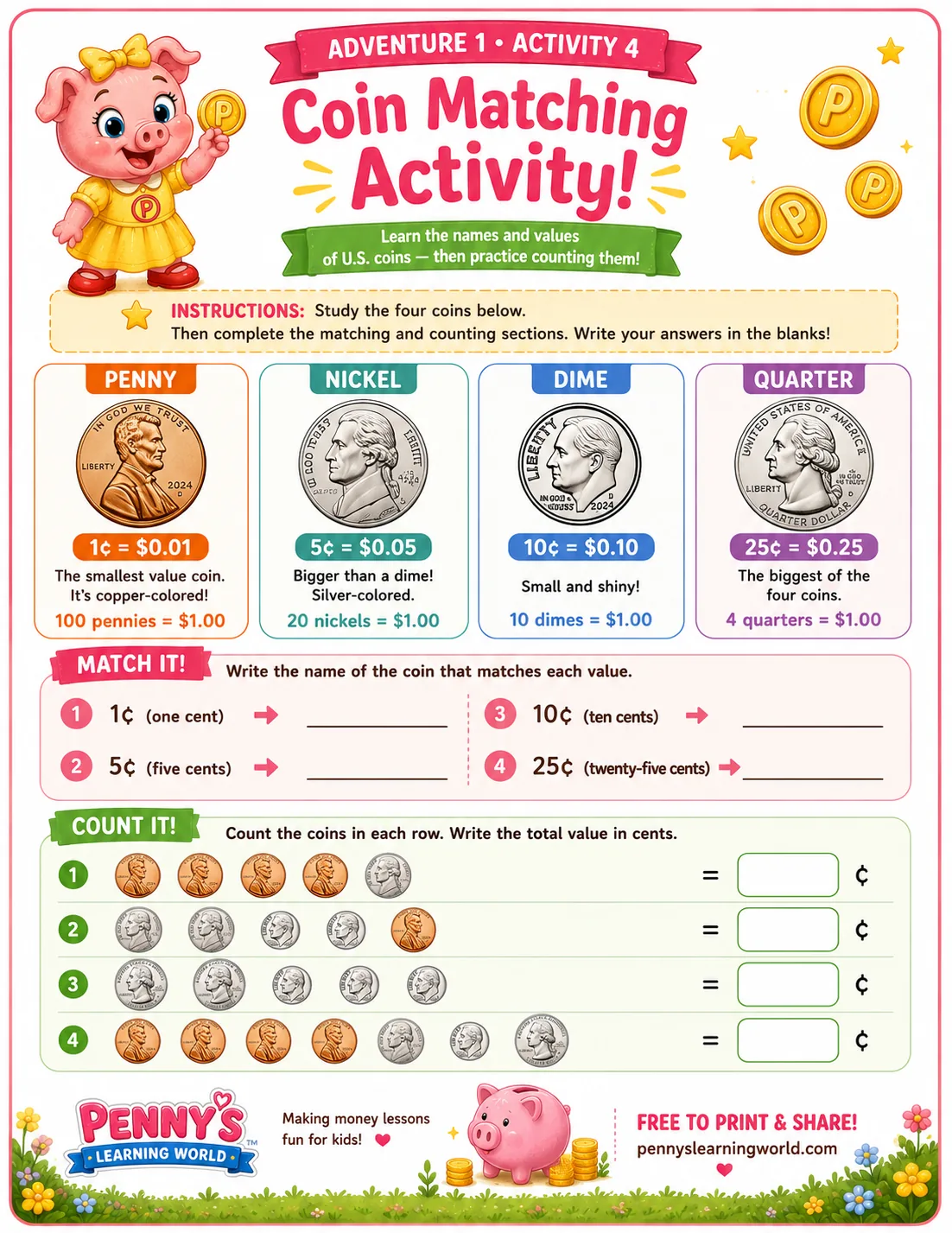
This single-page printable is designed to sit on the kitchen table right next to a small handful of real coins. The top section of the page shows illustrated pictures of all four common US coins: the penny, nickel, dime, and quarter. Children draw lines from each coin picture to three matching boxes — its name, its value in cents, and a fun fact about what makes it unique. Penny the Pig's friendly face appears in the corner cheering them on.

The coin matching section is deliberately simple so that even children on the younger end of the 4–7 range can succeed independently. Clear illustrations highlight the features that help children tell coins apart in real life: the penny's warm copper color, the nickel's larger size despite lower value, the dime's surprisingly small size, and the quarter's distinctive ridged edge and larger face.

At the bottom of the page sits the Coin Counter challenge — an extension activity that shows a mixed collection of coins and asks children to count the total value and write it in a blank. This section adds a meaningful step up in difficulty, making the same printable useful whether your child is just beginning to identify coins or is ready to practice basic addition with money. Parents can use the Coin Counter as a conversation starter: "Which coin would you add first to make it easier to count?" That kind of number-sense thinking is exactly what early financial literacy looks like in practice.

For more structured money learning, explore our financial literacy for kids resource hub, which links to activities organized by age and skill level — coin recognition is just the first stop on a much more rewarding journey.

What Children Learn

👁️

Coin Recognition

Children learn to identify each coin by its size, color, feel, and design markings — building visual and tactile memory they can use at a store or piggy bank.

⚖️

Value Comparison

The worksheet highlights the surprising fact that a smaller coin (the dime) can be worth more than a bigger one (the nickel) — a concept that genuinely delights young children when it clicks.

🔢

Counting Skills

The Coin Counter challenge at the bottom asks children to add up a mix of coins and write the total — connecting coin knowledge to real number skills in a concrete, meaningful way.

💬

Money Vocabulary

Children practice the words penny, nickel, dime, quarter, cent, and value — foundational vocabulary they will use in every future money conversation, from allowance to savings goals.

How to Use It

This worksheet works best as a short, low-pressure activity — ten to fifteen minutes at the kitchen table with a small pile of real coins nearby. Here is the approach that works best for most families:

  1. 1 Gather a small set of real coins — one penny, one nickel, one dime, and one quarter — and place them on the table next to the printed worksheet. Having physical coins beside the page makes the experience hands-on from the very first moment.
  2. 2 Let your child hold each coin while looking at its picture on the page. Talk about what they notice: "This one is smaller than the nickel — but look, it's actually worth more!" Curiosity-first conversations make the learning stick far longer than rote memorization.
  3. 3 Draw lines matching each coin to its name, value, and fun fact. Let younger children (ages 4–5) work on the matching section while you sit nearby; older children (ages 6–7) may want to try it completely independently before checking together.
  4. 4 Try the Coin Counter challenge at the bottom. Count the mixed coins shown on the page and write the total in the blank. For children who are new to adding coin values, work through it together, grouping the larger coins first. Children ages 7+ often enjoy the challenge of doing this section on their own and then comparing their answer with yours.

Coin recognition is where most children's money education begins, and for good reason — coins are the most tangible, portable form of money a young child can actually touch and use. When a child holds a dime in one hand and a nickel in the other and realizes the smaller coin is worth twice as much, something genuinely interesting happens in their understanding of value. That "wait, really?" moment is worth more than any flash card.

This worksheet pairs beautifully with our Kids Savings Challenge, which gives children a simple goal-setting framework once they can reliably count coins. Many families complete the coin matching worksheet first, then use the savings challenge as a next step — it gives children a reason to keep sorting those coins in their piggy bank week after week.

Frequently Asked Questions

When should children start learning to identify coins?

Most children can begin coin recognition between ages 4–5, starting with the penny (the most familiar). By age 6–7, most can identify all four coins and understand basic value relationships. The trickier concept — why a small dime is worth more than a larger nickel — usually clicks around age 6 with hands-on practice.

What is the Coin Counter challenge on the worksheet?

The Coin Counter challenge shows a picture of mixed coins and asks children to count the total value. It's an extension activity: most children ages 5–6 can do the matching section independently, then try the Counter with a parent's help. Children ages 7+ can often do both sections on their own.

Should I use real coins alongside the worksheet?

Strongly recommended. Physical coins provide tactile feedback that paper can't replicate — the weight, texture, and size differences become concrete when children can hold them. Keep a small pile of real coins on the table so children can compare what they see on the page to what they feel in their hands.