Free Printable · Ages 5–8 · Goal Planning

Penny's Goal Setting Worksheet for Kids

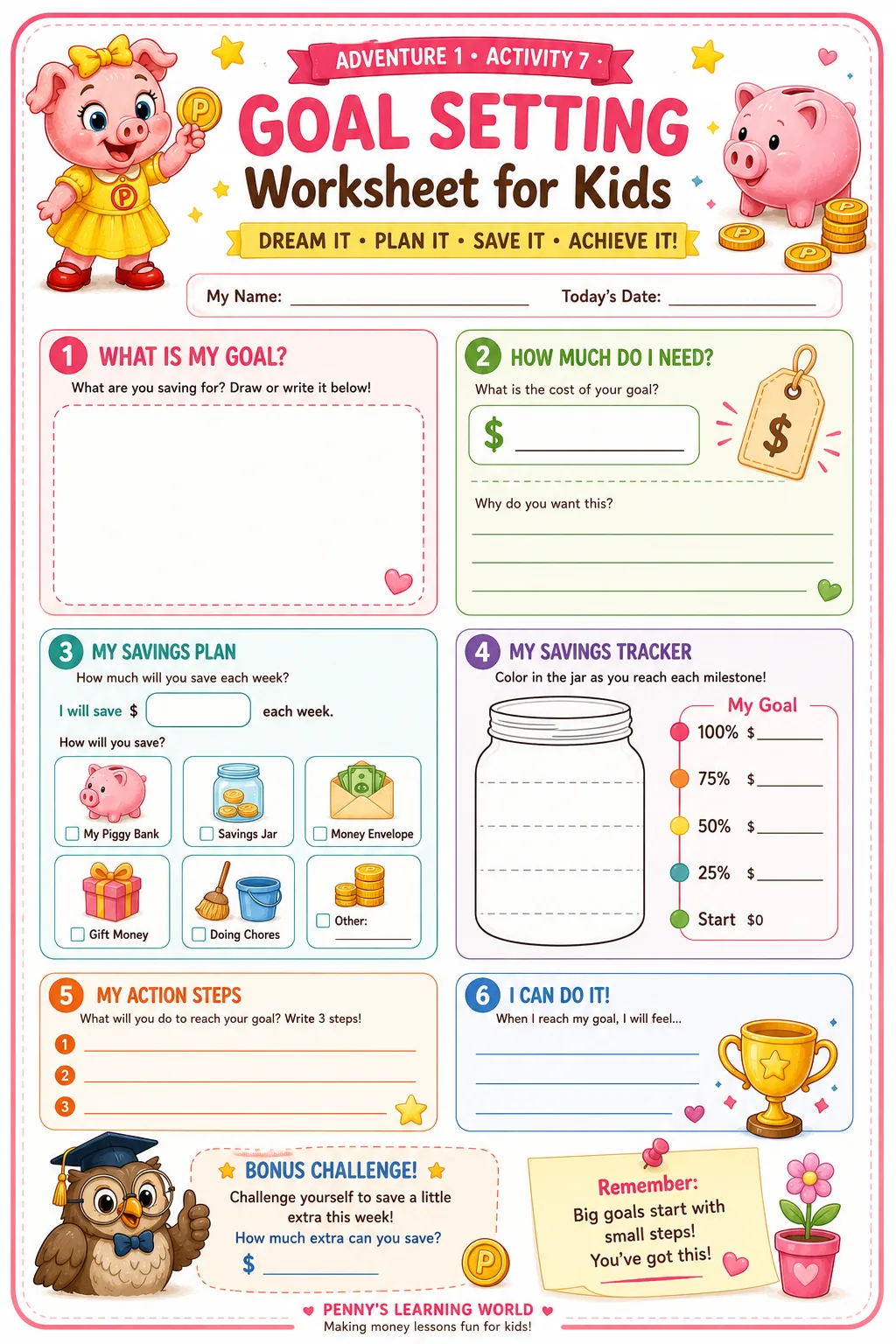
A one-page printable that turns a child's wish into a real plan — with a goal box, a savings ladder to color in, and a celebration prompt waiting at the finish line.

Get Free Printable

What's Inside the Printable

This printable is a single-page goal planning tool designed for children ages 5 through 8. At the top, children draw or write the item they want to save for — a physical drawing space makes the goal feel real and personal before a single coin hits the piggy bank. Below the drawing box, your child writes in the target amount and where the money will be kept (a jar, a piggy bank, a savings account).

The centerpiece of the sheet is the five-rung Steps to My Goal ladder. Each rung represents one milestone along the saving journey. Children color in a rung each week — or each time they hit a savings checkpoint — so they can see their progress climbing toward the top. That visual feedback is powerful: young children understand "I am at rung 3, I need to reach rung 5" far more concretely than they understand abstract dollar amounts. The ladder turns an invisible process into something they can see and touch.

At the bottom, a "People Who Can Help Me" section invites children to name the adults and older siblings they can count on — reinforcing the idea that working toward a goal is something families do together. And at the very top of the sheet, a small celebration prompt sits waiting: "When I reach my goal, I will celebrate by..." Filling that in on day one gives children something to look forward to the whole time they save. The promise of a real, named celebration makes the finish line feel close even when it isn't.

The worksheet pairs naturally with our financial literacy for kids resource hub, where you'll find reading guides, conversation starters, and activity ideas to extend the money learning beyond a single sheet.


What Children Learn

Each element of this worksheet is designed around a specific developmental benefit for early childhood money learning. Here is what your child practices every time they sit down with this sheet:

Goal Visualization

Drawing the desired item makes the goal concrete and motivating. When children create a visual representation of what they're saving for, it activates the imagination and anchors the goal in something emotionally real — not just a number.

Planning & Estimation

Estimating how many weeks it will take and breaking the total into ladder rungs creates a mental roadmap. Children begin to understand that big outcomes are the result of many small, consistent steps — an insight that serves them far beyond money.

Self-Efficacy

Completing each rung of the ladder builds confidence in the saving process. Every time a child colors in a rung, they feel the quiet pride of progress made. Repeated small wins stack into a genuine belief: "I can do this when I set my mind to it."

Community & Support

Identifying the people who can help teaches children that goals involve support from others. Naming a grandparent, a parent, or an older sibling as a helper normalizes asking for guidance — and opens a door for those helpers to actively participate.


How to Use It — Step by Step

Set aside five to ten minutes together. You do not need any supplies beyond the printed sheet, a pencil, and some crayons or markers for the ladder. Here is the flow that works best:

  1. Ask your child: "What's something you really want that costs more than you have right now?" Let them answer without steering — their answer is the goal. If they say "I don't know," offer two or three real choices you've seen them excited about and let them pick.
  2. Help them write or draw the goal at the top of the sheet. Younger children (ages 5–6) typically prefer drawing; older children (ages 7–8) often like writing the name plus drawing. Either approach is equally valid. The act of putting it on paper makes the goal feel official.
  3. Look up the price together — on the store's website, on a physical price tag, or from memory — and write the target amount in the box. Involve your child in this step. Knowing the real price is part of the lesson.
  4. Decide how much to save each week, then divide the total to estimate how many weeks it will take. Write that number on the sheet. If the number feels big, this is a great moment to talk about milestone goals — saving the first quarter of the total before thinking about the rest.
  5. Color in one rung of the ladder each week as savings grow toward the goal. Make this a small weekly ritual — Saturday morning after breakfast, or Sunday evening. Keep the sheet somewhere visible so your child sees their progress every day without having to think about it.

"Slow and steady — that's how I save. I pick one thing I really want, I write it down so I don't forget, and then I put a little money away every week without rushing. Before I know it, I'm at the top of the ladder. You can do it too. The ladder is just little steps, one rung at a time."

Tucker the Turtle, Penny's patient and persistent saving buddy

Tucker the Turtle embodies the slow-and-steady approach to saving — he knows that patience is a skill, not a personality type, and that it can be practiced. If your child struggles with delayed gratification (most children ages 5–8 do — it is developmentally normal), Tucker's calm persistence can be a great reference point: "What would Tucker do this week?" is a surprisingly effective question.

Want to introduce Tucker before starting the worksheet? Head to the Kids Savings Challenge for a fun family activity that pairs beautifully with this printable and gives Tucker a starring role in your child's first saving adventure.


Frequently Asked Questions

What makes a good first savings goal for a child?

The best first goal is something the child genuinely wants, costs between $5–$20, and can be reached within 4–8 weeks at a realistic savings rate. A specific toy, a book, or a special activity all work well. The goal should be concrete — not "something fun" but "that specific Lego set." Specificity fuels motivation through the full timeline. A goal that is vague tends to fade before the money is saved, while a goal with a face — a name, a picture — stays vivid in a child's mind from the first rung to the last.

My child wants to save for something that costs $200. Is that too big?

For most children under age 7, a $200 goal is too abstract — the timeline is too long to sustain motivation. Set a "milestone goal" instead: save toward the first $20. When they hit it, celebrate, then set the next milestone. This keeps wins coming and teaches children that big goals are a series of smaller ones stacked together. You can even use a second copy of the worksheet for the next milestone, so the child builds a visible stack of completed sheets — a portfolio of goals reached that reinforces their identity as a saver.

What if my child reaches the goal but then spends the money on something else?

That is a genuine learning moment. Afterward (without judgment), ask: "How do you feel now?" and "Is there anything you'd do differently?" Children who experience the natural consequence of spending their savings impulsively often become the most committed savers by the second or third goal — they have felt both sides and prefer the goal. Avoid expressing disappointment or turning it into a lecture. Curiosity is more powerful than correction at this age, and the worksheet will be there whenever they are ready to try again.

Get Your Free Penny's Goal Setting Worksheet for Kids ✉️

Join Penny's Clubhouse — your free printable arrives in the welcome email.

For parents. We only email about Penny's Learning World.